Cacciaguida
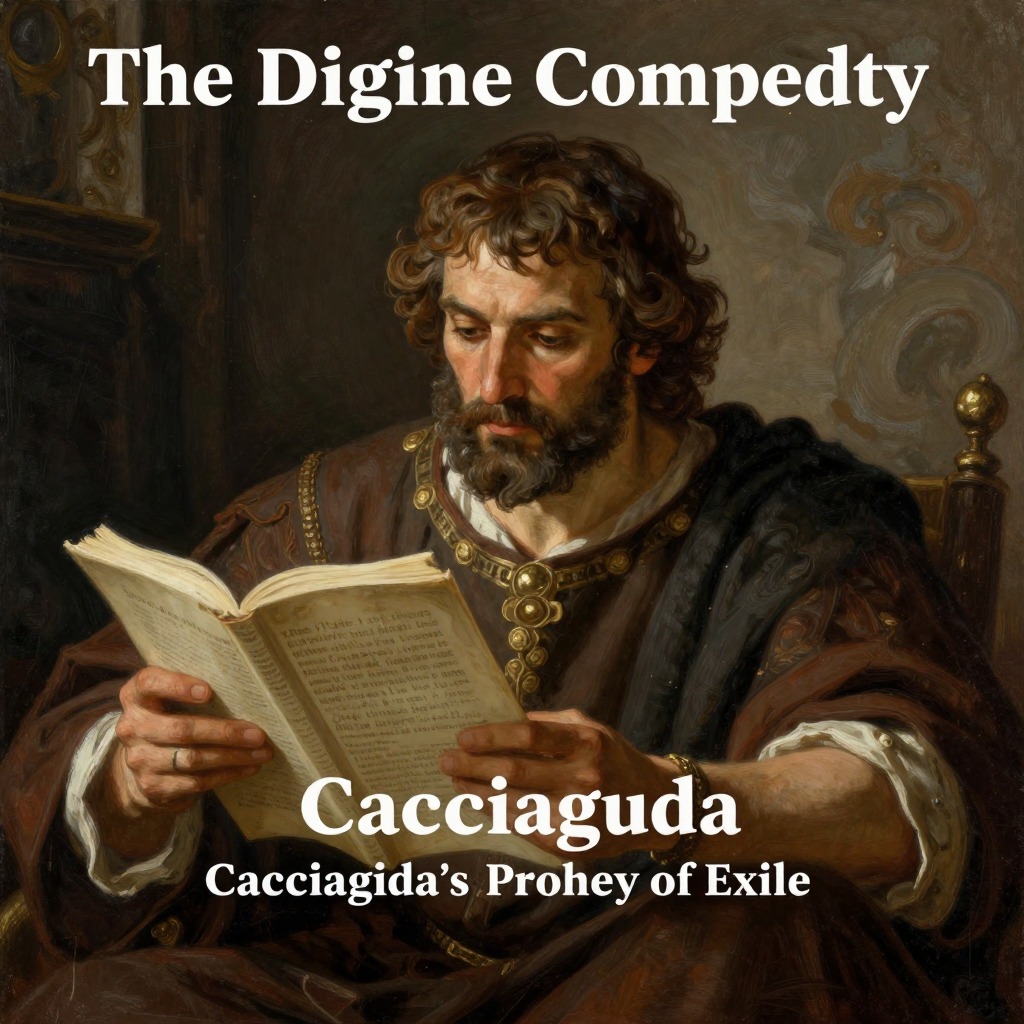
Cacciaguida, the great-great-grandfather of Dante Alighieri, is a central figure in the Heaven of Mars, the fifth sphere of Paradise reserved for martyrs and crusaders who died fighting for the true faith. He appears to Dante as a brilliant light within the celestial cross, and his role is unique: he is the only ancestor Dante meets in the afterlife, and his words provide the poet with a definitive account of his family's origins, a nostalgic vision of Florence's past, and a clear, painful prophecy of his future exile. Cacciaguida thus functions as the patriarchal voice of truth, grounding Dante's personal history within the divine order and authorizing his poetic mission.
Identity and Ancestry
Cacciaguida identifies himself as the son of Dante's great-grandfather, born in Florence and baptized in the city's ancient Baptistery of San Giovanni. He reveals that his own ancestors lived in the city's oldest quarter, near the present-day market, and that his wife came from the Val di Pado, from whom the Alighieri surname derived. He describes a Florence of the late 11th and early 12th centuries that was peaceful, temperate, and chaste, within its ancient boundary from which it still took its tierce and nones. The city's women were content with simple attire, and its men were known for their martial valor and civic virtue. Cacciaguida himself followed the Emperor Conrad to fight against the law's iniquity, was knighted by him, and died a martyr in the Holy Land, thus earning his place among the blessed in Mars.
Life and Plot Trajectory
Cacciaguida's life is recounted in a series of revelations to Dante. He explains that he was born when the planet Mars had returned to its position in the constellation Leo five hundred fifty times and thirty more after the Ave Maria. He names his brother Moronto and Eliseo, and states that his wife came from the Val di Pado. He then describes his military service under Emperor Conrad, his knighthood, and his death in battle against the Saracens, which he calls a martyrdom that released him from the bonds of the fallacious world. This trajectory from a peaceful Florentine citizen to a crusader and martyr establishes him as a model of the active, virtuous life that Dante is called to emulate.
Key Actions and Objectives
Cacciaguida's primary action is to speak truth to Dante. He first praises the ancient Florentine families, listing the Ughi, Catellini, Filippi, Greci, Ormanni, and Alberichi, among others, and contrasts their integrity with the corrupt newcomers who have since flooded the city. He then delivers the prophecy of Dante's banishment, stating that the poet must leave Florence as Hippolytus left Athens, driven out by a false and cruel step-dame. He specifies that Dante's first refuge will be with the great Lombard lord, Bartolomeo della Scala, who bears the holy bird on the ladder, and that he will see there a young boy, Can Grande, whose future deeds will be notable. Cacciaguida's objective is to prepare Dante for his exile and to encourage him to write his vision without fear, for the truth, though bitter, will leave a vital nutriment.
Relationships and Conflict
The relationship between Cacciaguida and Dante is one of profound filial piety and ancestral pride. Dante addresses him as "my beloved root ancestral" and feels his own hardihood to speak increase. Cacciaguida responds with paternal love, calling Dante "my leaf" and expressing the joy he felt even while awaiting him. The conflict is not between them but between Dante and his future enemies: the corrupt Florentine factions, the avaricious papacy, and the foolish companions who will turn against him. Cacciaguida warns Dante that the blame for his exile will fall on the offended party, but that the vengeance will witness to the truth. He also advises Dante to make a party by himself, as his companions will prove ingrate, mad, and impious.
Change and Ending
Cacciaguida's revelation transforms Dante's understanding of his own life and mission. The prophecy of exile, which had been hinted at by other souls in Hell and Purgatory, is now made explicit and personal. Dante, who had feared that his truthful account might lose him friends, is emboldened by Cacciaguida's command to "make manifest thy vision utterly." The encounter ends with Cacciaguida's light flashing like a golden mirror in the sunshine, and he then falls silent, having completed his task. Dante, now armed with this knowledge, continues his ascent through the heavens, his resolve strengthened to write the poem that will condemn the wicked and exalt the just.
Narrative Role and Evaluation
Cacciaguida serves as the patriarchal authority who validates Dante's entire poetic enterprise. He is the only figure in the entire Comedy who provides Dante with a detailed genealogy and a direct prophecy of his personal future. His speech is the most sustained and intimate revelation of Dante's own life within the poem, and it is delivered with the authority of a martyr and the love of a father. Cacciaguida's presence in the Heaven of Mars, the sphere of warriors, underscores the theme of spiritual combat: Dante's exile is not merely a political misfortune but a crusade for truth. Through Cacciaguida, Dante receives the mandate to write his "sacred poem" without fear, knowing that his words, though they may offend, will ultimately serve the divine justice.